Bacterial Cell Structure
In brief:Bacteria are unicellular prokaryotic microorganisms (1–5μm). They lack a nucleus and membrane-bound organelles but have unique structures.
Bacteria are unicellular prokaryotic microorganisms, typically 1–5μm in size. They are the most abundant organisms on Earth.
Key features of bacterial cells:
• No membrane-bound nucleus - DNA is loose in the cytoplasm (nucleoid region)
• No membrane-bound organelles (no mitochondria, no ER, no Golgi)
• 70S ribosomes (smaller than eukaryotic 80S ribosomes)
• Chromosomal DNA: single circular chromosome, no histones
Unique bacterial structures:
• Plasmid: small circular DNA separate from chromosomal DNA. Can transfer between cells (conjugation). Often carries antibiotic resistance genes - a major medical concern.
• Cell wall: made of peptidoglycan (not cellulose). Gives shape and prevents bursting.
• Capsule/slime layer: prevents drying out, provides protection from white blood cells (phagocytosis)
• Flagellum: whip-like structure for movement (not all bacteria have one)
• Pili: short hair-like projections for attachment to surfaces and other cells
Three bacterial shapes: Coccus (spherical, e.g. Streptococcus), Bacillus (rod, e.g. E. coli), Spirillum (spiral, e.g. Treponema)
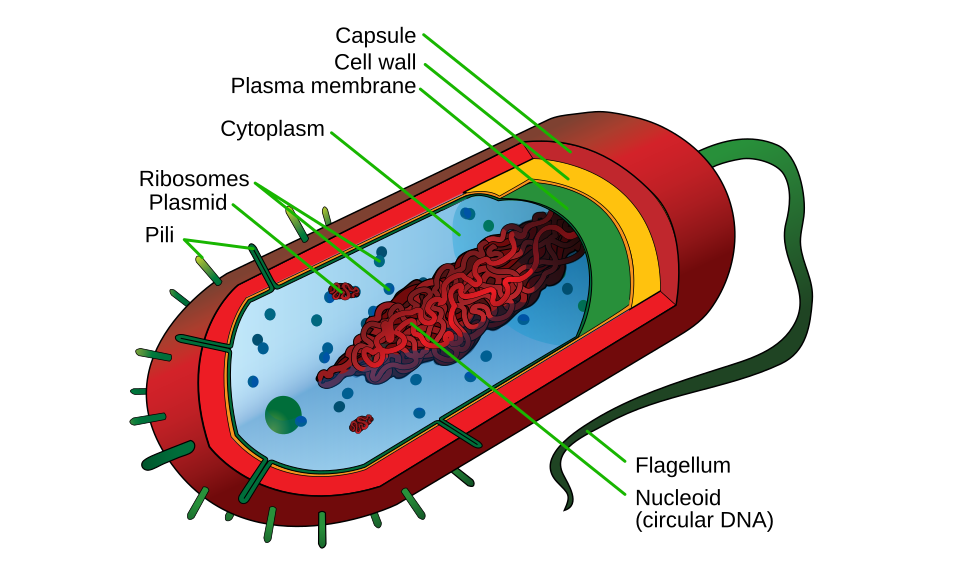
Bacterial (prokaryotic) cell
Wikimedia Commons (public domain / CC)
Bacterial Cell Structure
Three Bacterial Shapes
| Shape | Name | Description | Example |
|---|---|---|---|
| Sphere | Coccus | Spherical | Streptococcus, Staphylococcus |
| Bacillus | Rod-shaped | E. coli, Bacillus subtilis | |
| Spiral | Spirillum | Spiral/corkscrew | Treponema (syphilis) |
Key Points
- 1Chromosomal DNA: loose in cytoplasm, no associated histone proteins (unlike eukaryotes).
- 2Plasmid: small circular DNA that can transfer between cells. Often carries antibiotic resistance genes.
- 3Cell membrane: selectively permeable, controls substances in/out. Made of phospholipids and proteins.
- 4Cell wall: gives shape and strength. Made of peptidoglycan (not cellulose like plants).
- 5Capsule/slime layer: prevents drying out, protects from white blood cell phagocytosis. Not in all bacteria.
- 6Flagellum: hair-like structure for movement. Not in all bacteria.
- 7Pili: small hair-like structures for attachment to surfaces and other cells.
- 8Three bacterial shapes: coccus (spherical), bacillus (rod), spirillum (spiral).
Learning Outcomes
- Compare the structure of prokaryotic and eukaryotic cells
- Distinguish between bacteria and fungi in terms of structure, nutrition, and cellular nature