1.2 Biomolecules
In brief:Living cells contain four main types of biomolecule: carbohydrates, lipids, proteins, and nucleic acids. Each has distinct structures and roles.
Living cells contain four main types of biomolecule: carbohydrates, lipids, proteins, and nucleic acids. Each is built from smaller subunits (monomers) joined together.
Carbohydrates (Cₓ(H₂O)y) - energy and structure:
• Monosaccharides: single sugars - glucose, fructose, galactose (6-carbon sugars)
• Disaccharides: two monosaccharides joined by a glycosidic bond - sucrose (glucose + fructose), maltose, lactose
• Polysaccharides: long chains - starch (plant storage), glycogen (animal storage), cellulose (plant cell walls)
Lipids - energy storage, insulation, membranes:
• Triglyceride = glycerol + 3 fatty acids (joined by ester bonds)
• Phospholipids = glycerol + 2 fatty acids + phosphate group → forms cell membrane bilayer
• Saturated fats: no C=C double bonds (solid at room temp). Unsaturated: has C=C double bonds (liquid)
Proteins - enzymes, hormones, antibodies, structural:
• Built from amino acids linked by peptide bonds (condensation reaction)
• 4 levels of structure: primary (sequence), secondary (α-helix/β-sheet), tertiary (3D fold), quaternary (multiple polypeptides)
Nucleic acids - store and transmit genetic information:
• Built from nucleotides: sugar + phosphate + nitrogenous base
• DNA: deoxyribose, double-stranded, bases A-T and G-C
• RNA: ribose, single-stranded, bases A-U and G-C

Glucose — a monosaccharide carbohydrate
Wikimedia Commons (public domain / CC)

Sucrose — glucose + fructose (disaccharide)
Wikimedia Commons (public domain / CC)
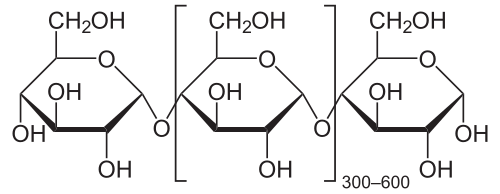
Amylose — a polysaccharide (starch)
Wikimedia Commons (public domain / CC)
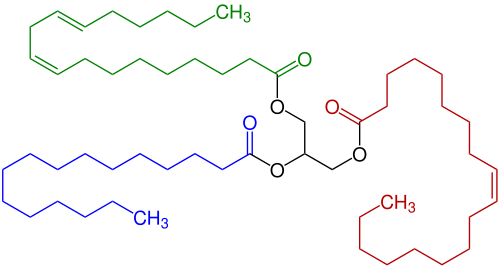
Triglyceride — glycerol + 3 fatty acids
Wikimedia Commons (public domain / CC)
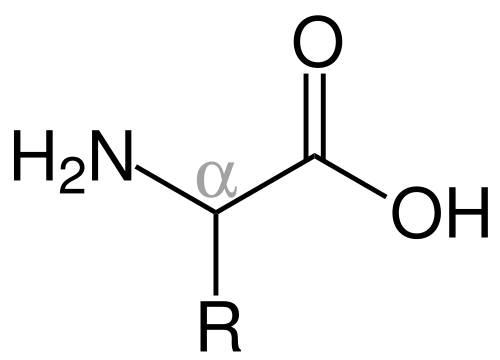
Amino acid — building block of proteins
Wikimedia Commons (public domain / CC)
The Four Biomolecules
| Biomolecule | Elements | Monomer | Bond | Functions |
|---|---|---|---|---|
| Carbohydrate | C, H, O | Monosaccharide | Glycosidic | Energy, structure (cellulose) |
| Lipid | C, H, O | Glycerol + fatty acids | Ester | Energy storage, membranes, insulation |
| Protein | C, H, O, N (S) | Amino acid | Peptide | Enzymes, hormones, transport, structure |
| Nucleic acid | C, H, O, N, P | Nucleotide | Phosphodiester | Genetic information (DNA, RNA) |
Carbohydrate Hierarchy
glucose, fructose
1 sugar unit
Disaccharide
sucrose, maltose
2 sugar units bonded together
Polysaccharide
starch, glycogen, cellulose
Many sugar units
Protein Structure Levels
Key Points
- 1Carbohydrates (Cₓ(H₂O)y): monosaccharides (glucose), disaccharides (sucrose), polysaccharides (starch, glycogen, cellulose).
- 2Lipids: triglyceride unit - glycerol + 3 fatty acids. Include fats, oils, phospholipids.
- 3Proteins: chains of amino acids (peptides → polypeptides) folded into 3D shapes. Contain C, H, O, N (sometimes S, P).
- 4Protein roles: enzymes, hormones, channel proteins, transporters, structural proteins, receptors, antibodies.
- 5Nucleic acids: DNA and RNA made of nucleotide subunits.
- 6ATP, NAD⁺ and NADP⁺ are transfer molecules in metabolic pathways.
Learning Outcomes
- Outline the structures and metabolic roles of carbohydrate, lipid and protein, and identify nutritional sources of each
- Describe the basic structure and function of a DNA and RNA nucleotide
- Outline the role of ATP, NAD+ and NADP+ in metabolic pathways