1. Fossil Evidence (Palaeontology)
Fossils are the preserved remains or traces of organisms that lived long ago - bones, teeth, shells, seeds, pollen, leaf prints, footprints and even faeces. They are found in sedimentary rock, ice, amber and peat bogs. They are dated using radiocarbon dating (accurate up to ~30,000 years) and potassium-argon dating (up to ~1,200 million years).
What the fossil record shows:
- Younger fossils are more complex and more similar to living organisms.
- Older rock layers contain fewer species - biodiversity has increased over time.
- Many modern species (e.g. the modern horse) have no fossil counterparts.
- Many fossil species (e.g. dinosaurs, the dodo) are extinct today.
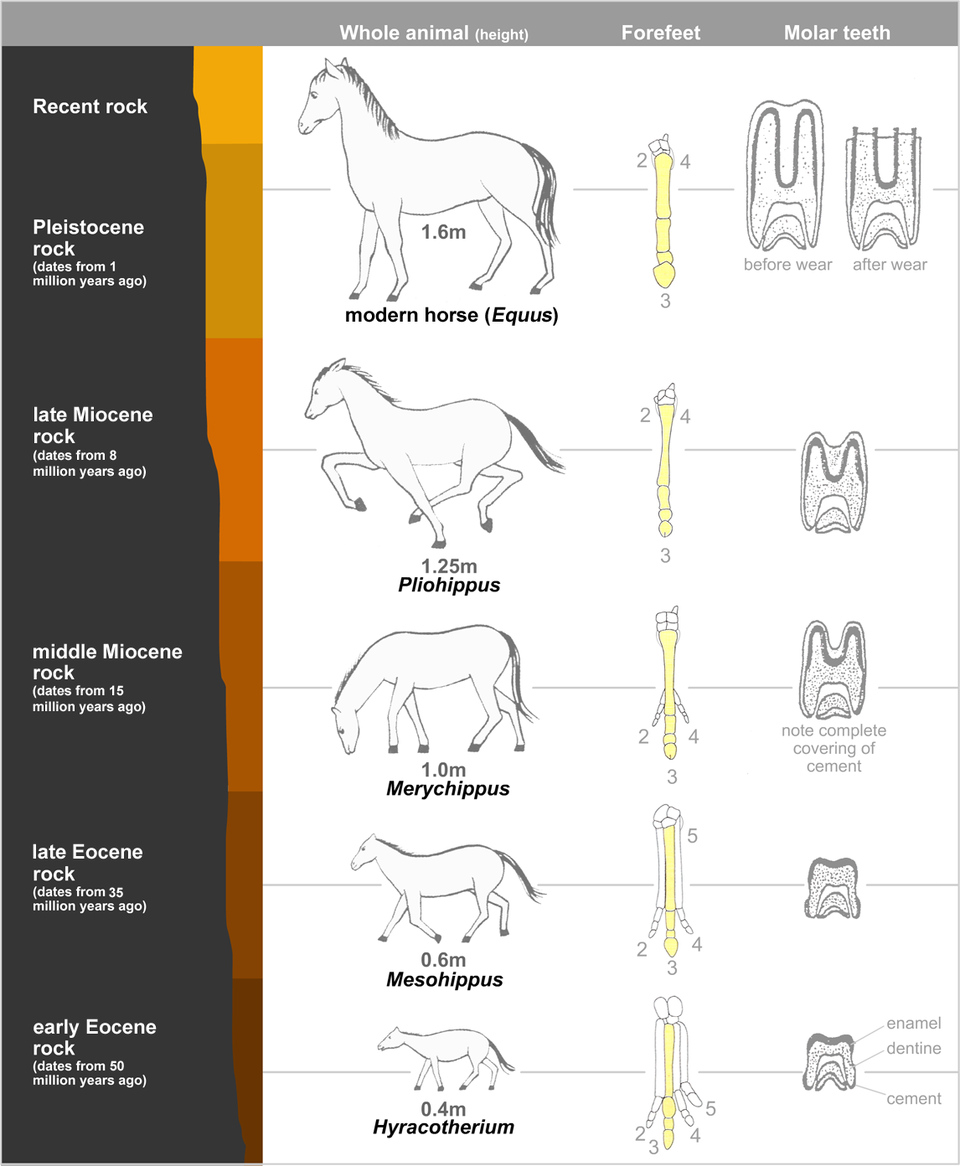
Evolution of the horse - a classic fossil sequence tracking one trait, height:
- 60 million years ago: Eohippus, ~0.4 m tall (fox-sized)
- 30 million years ago: ~0.6 m tall
- 10 million years ago: ~1 m tall
- 1 million years ago: Equus, the modern horse, ~1.6 m tall
Over 60 million years horses grew larger, reduced from four toes to a single hoof (better for running on hard ground) and developed ridged molars for grinding tough grass rather than soft foliage. These changes match the shift from marshy woodland to open grassland.
Limits of the fossil record: soft tissues rarely fossilise, older fossils are hard to date, most organisms never fossilised at all, and many fossils are destroyed by erosion.
2. Comparative Anatomy
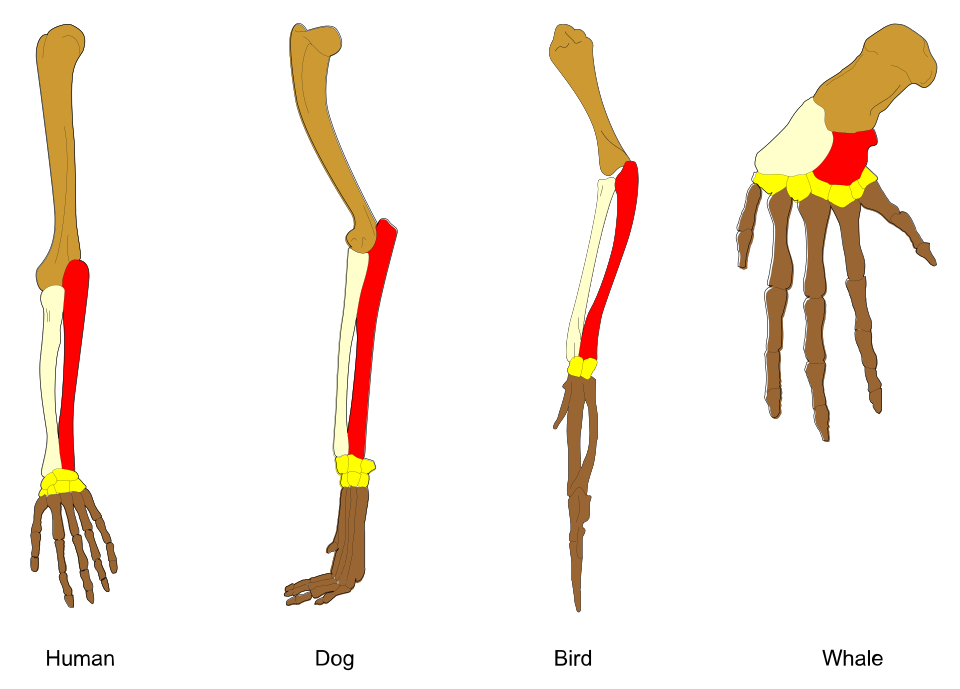
The pentadactyl (five-fingered) limb appears in the arm of a human, the wing of a bat, the flipper of a whale, the foreleg of a mole and the leg of a horse. All share the same underlying bone pattern but are adapted to very different functions - grasping, flying, swimming, digging or running. This is called adaptive radiation from a common ancestor.
Homologous structures - organs with the same basic structure but different functions - point to shared ancestry. Vestigial structures are reduced remnants of features that once had a purpose (e.g. the second and fourth toes of the horse survive as tiny splint bones).
3. Comparative Embryology
Early embryos of vertebrates as different as humans, fish, birds and tortoises look strikingly similar - all have a tail, gill slits (which become the Eustachian tube in humans), a notochord and similar brain and eye position. This suggests they inherited a shared embryological plan from a common ancestor.
4. Comparative Biochemistry
All living cells share the same core biochemical pathways (e.g. respiration) and use very similar molecules (e.g. haemoglobin in vertebrate blood). Comparing DNA and protein sequences between species is the most powerful modern evidence - the closer the sequences match, the more closely the species are related.