1. Genetic Engineering & DNA Profiling
In brief:Genetic engineering alters an organism's DNA. DNA profiling creates a unique genetic 'fingerprint' for identification.
Genetic Engineering (GM)
Genetic engineering involves artificially altering an organism's DNA by transferring a gene from a donor to a host organism, creating a genetically modified organism (GMO).
- Gene isolation: locate the desired gene
- Cutting: use restriction enzymes to cut the gene from donor DNA and cut open a bacterial plasmid
- Insertion: use ligase enzyme to splice the gene into the plasmid
- Transformation: insert the recombinant plasmid into a host cell (e.g. bacterium)
- Expression: the host cell expresses the new gene, producing the desired protein
Examples: human insulin produced by GM bacteria; Bt crops resistant to insects; Golden Rice with vitamin A.
DNA Profiling
Creates a unique genetic 'fingerprint' using non-coding DNA (which varies between individuals).
- DNA extracted from sample
- DNA amplified using PCR
- DNA cut with restriction enzymes
- Fragments separated by gel electrophoresis
- Pattern of bands = DNA profile
Uses: forensic identification, paternity testing, solving crimes, identifying genetic disorders.
PCR (Polymerase Chain Reaction)
A technique to amplify (make millions of copies of) a small DNA sample. Uses cycles of heating and cooling with DNA polymerase.
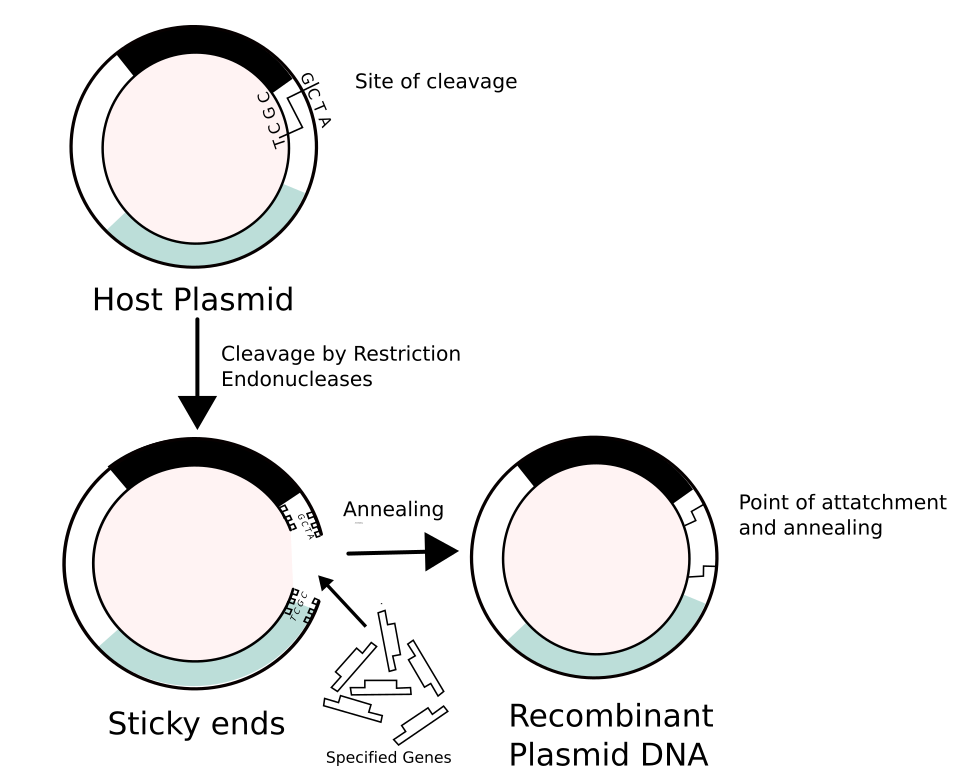
Genetic engineering: recombinant plasmid formation
Wikimedia Commons (CC)
Key Points
- 1Genetic engineering: transfer a gene from donor to host using restriction enzymes and ligase
- 2GMO examples: human insulin from bacteria, Bt crops, Golden Rice
- 3DNA profiling uses non-coding DNA to create a unique genetic fingerprint
- 4Gel electrophoresis separates DNA fragments by size
- 5PCR amplifies tiny DNA samples into millions of copies
- 6Applications: forensics, paternity testing, genetic disorder screening
Learning Outcomes
- Outline the concept of genetic engineering and its applications
- Outline what is meant by DNA profiling and its potential uses
- Model the steps involved in generating a DNA profile
- Outline the principle of DNA sequencing
- Use a genome database to search for alleles that are known to cause (or be responsible for) specific genetic diseases
- Investigate patterns using a DNA profile, use primary or secondary data to support conclusions