All topics
Practice this topic

Strand 1: Organisation of Life

Genetic Inheritance

Chromosomes, DNA, Mendel's Laws, monohybrid and dihybrid crosses, sex-linkage, and epigenetics.

1.4 Chromosomes & DNA

In brief:Genetic information is stored on chromosomes in the nucleus. Understanding chromosome structure and key genetic concepts is essential.

Chromosomes are structures in the nucleus made of DNA wrapped tightly around histone proteins. Humans have 46 chromosomes (23 pairs) - 22 pairs of autosomes and 1 pair of sex chromosomes (XX or XY).

Structure of a chromosome:
• Each chromosome consists of two chromatids joined at the centromere
• DNA exists as chromatin (loose) during interphase, and condenses into visible chromosomes during division
• DNA contains both coding regions (genes) and non-coding regions (formerly called 'junk DNA')

Key terms:
Gene: a section of DNA that codes for a specific protein
Allele: different versions of the same gene (e.g. B = brown eyes, b = blue eyes)
Genotype: the alleles an organism carries (BB, Bb, bb)
Phenotype: the observable characteristic (brown eyes, blue eyes)
Dominant: expressed when one or two copies present (B)
Recessive: only expressed when two copies present (bb)

Epigenetics: changes in gene expression caused by environment or behaviour without altering the DNA sequence. E.g. identical twins can develop different traits due to different environments affecting which genes are switched on/off.
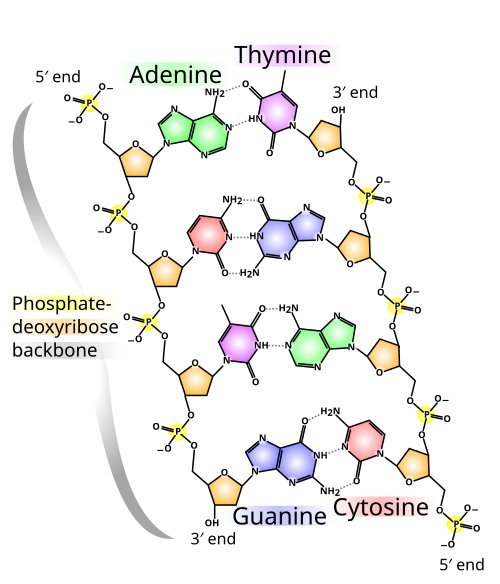
DNA double helix chemical structure

DNA — double helix with base pairing

Wikimedia Commons (public domain / CC)
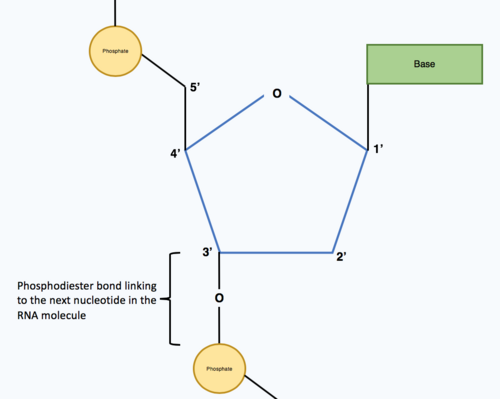
DNA nucleotide structure

Nucleotide — phosphate, sugar, base

Wikimedia Commons (public domain / CC)

diagram

DNA → Chromosome Structure

DNA Double Helix
DNA + Histones
Chromatin Fibre
Chromosome
(2 chromatids + centromere)

Key Points

  • 1Chromosome: DNA wrapped around histone proteins. Consists of two chromatids joined at the centromere.
  • 2Gene: a section of DNA that codes for a specific protein.
  • 3Allele: different forms of the same gene (e.g. brown eyes vs blue eyes).
  • 4Genotype: the genetic makeup of an organism. Phenotype: the observable characteristics.
  • 5Dominant allele masks the recessive allele in heterozygous individuals.
  • 6Nuclear inheritance: via DNA in the nucleus. Non-nuclear: mitochondrial/chloroplast DNA.
  • 7Epigenetics: how behaviours and environment can influence gene expression without changing DNA sequence.

Learning Outcomes

  • Describe the structure of a chromosome and the role of a gene
  • Explain what is meant by nuclear inheritance; compare to non-nuclear inheritance
  • Compare genetic and epigenetic mechanisms; research one example of epigenetic inheritance in nature
  • Relate genes, proteins and traits in organisms; outline the concept of the genetic code

Mendel's Laws & Crosses

In brief:Gregor Mendel discovered the laws of inheritance through his pea plant experiments. These laws form the foundation of genetics.

Gregor Mendel (1822–1884), an Austrian monk, is the 'Father of Genetics'. He discovered the laws of inheritance through careful experiments with pea plants, tracking traits like height, seed colour, and flower colour over multiple generations.

Law of Segregation: Each organism has two alleles per gene. During gamete formation (meiosis), these alleles separate so each gamete receives only one allele.

Law of Independent Assortment: Genes on different chromosomes are inherited independently of each other. (Exception: linked genes on the same chromosome)

Monohybrid cross (one trait):
E.g. Tt × Tt → gametes: T, t × T, t
Punnett square: TT, Tt, Tt, tt → 3 tall : 1 short (phenotypic ratio)

Incomplete dominance: neither allele is fully dominant. Heterozygote shows a blended phenotype. E.g. red × white snapdragons → pink flowers.

Sex-linked traits: genes carried on the X chromosome. Males (XY) are more affected because they only have one X. E.g. colour blindness: XBXb (carrier female) × XBY → 50% sons colour blind.

table

Monohybrid Cross: Tt × Tt (Punnett Square)

Tt
TTT (Tall)Tt (Tall)
tTt (Tall)tt (Short)

Genotypic ratio: 1 TT : 2 Tt : 1 tt  |  Phenotypic ratio: 3 Tall : 1 Short

Key Points

  • 1Law of Segregation: each organism has two alleles for each gene; these separate during gamete formation.
  • 2Law of Independent Assortment: genes on different chromosomes are inherited independently.
  • 3Monohybrid cross: inheritance of one trait (e.g. Tt × Tt → 3 tall : 1 short).
  • 4Dihybrid cross: inheritance of two unlinked traits simultaneously.
  • 5Incomplete dominance: neither allele is fully dominant; heterozygote shows a blended phenotype.
  • 6Linkage: genes on the same chromosome tend to be inherited together, affecting independent assortment.
  • 7Sex-linkage: genes carried on the X chromosome (e.g. colour blindness, haemophilia).
  • 8Sex determination: XX = female, XY = male in humans.

Learning Outcomes

  • Model inheritance to the first generation of a single unlinked trait in crosses involving homozygous and heterozygous parents
  • Model a cross involving incomplete dominance
  • Illustrate and state Mendel's Laws of Segregation and Independent Assortment
  • Model inheritance to the second generation of two unlinked traits in crosses involving homozygous and heterozygous parents
  • Explain how linkage affects Mendel's Law of Independent Assortment (knowledge of crossing over not required)
  • Model sex determination by X and Y chromosomes in humans
  • Model the inheritance of sex-linked traits from known examples
  • Identify benefits and limitations of Mendelian genetics to our understanding of heredity in the modern world

Interactive: Punnett Square

Build a cross to predict genotype and phenotype ratios.

Interactive Punnett Square

Choose alleles for each parent. B = Brown eyes (dominant), b = Blue eyes (recessive). Ratios update live.

Parent 1
= Bb
Parent 2
= bb
bb
BBbBb
bbbbb
Genotype ratio
  • Bb2/4 (50%)
  • bb2/4 (50%)
Phenotype ratio
  • Brown eyes (dominant)50%
  • Blue eyes (recessive)50%
Presets:

Interactive: Sex-Linked Cross Generator

Model X-linked inheritance for haemophilia, colour blindness and DMD - see male vs female offspring outcomes.

XHY
XH
XHH
Unaffected female
XHY
Unaffected male
Xh
XhH
Carrier female
XhY
Affected male (Haemophilia)

Predicted offspring ratios

  • Unaffected females: 1/4 (25%)
  • Carrier females: 1/4 (25%)
  • Affected females: 0/4 (0%)
  • Unaffected males: 1/4 (25%)
  • Affected males: 1/4 (25%)

Capital letter = dominant allele on the X chromosome. Lower case = recessive. The Y chromosome carries no allele for this gene, so a single recessive allele expresses the trait in males.