1. Chromosomes, Genes & Epigenetics
In brief:Genes on chromosomes control inherited traits. Epigenetics studies how environment and behaviour affect gene expression without changing DNA.
Heredity
Heredity is the passing on of characteristics from parents to offspring via genes. A species is a group of organisms that can interbreed to produce fertile offspring.
Key Terms
- Locus: the location of a gene on a chromosome
- Allele: alternative forms of a gene (e.g. B = brown eyes, b = blue eyes)
- Homozygous: both alleles the same (BB or bb)
- Heterozygous: alleles are different (Bb)
- Genotype: the genetic make-up (e.g. Bb)
- Phenotype: the physical appearance (e.g. brown eyes)
- Dominant: allele expressed when present (capital letter)
- Recessive: only expressed in homozygous state (lowercase)
Nuclear vs Non-nuclear Inheritance
Nuclear DNA: inherited from both parents via meiosis (46 chromosomes).
Mitochondrial DNA: circular, ~37 genes, inherited only from the mother. Mutations cause mitochondrial diseases.
Chloroplast DNA: ~120 genes controlling photosynthesis, also maternally inherited.
Epigenetics
Epigenetics studies how behaviour and environment affect gene expression without changing the DNA sequence. Mechanisms include:
- DNA methylation: chemical group added to DNA, blocking gene expression
- Histone modification: changes how tightly DNA is packed, affecting gene access
Epigenetic changes are reversible and can be influenced by diet, stress, smoking, and pollution.
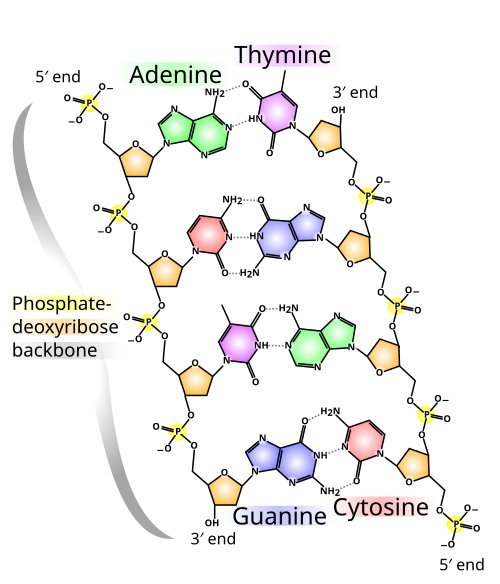
Chemical structure of DNA
Wikimedia Commons (CC)
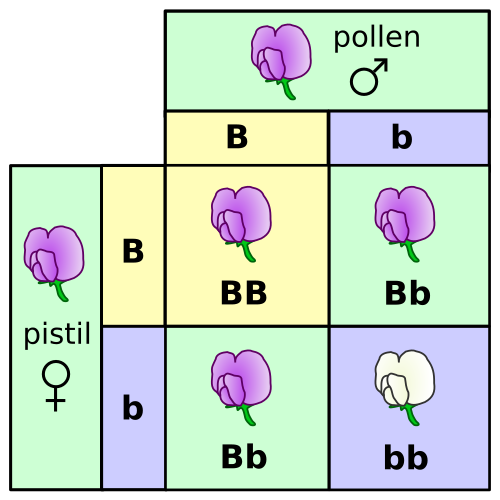
Punnett square showing monohybrid inheritance
Wikimedia Commons (CC)
Key Points
- 1Heredity: passing traits from parents to offspring via genes
- 2Alleles are alternative forms of a gene; dominant masks recessive
- 3Homozygous = same alleles; heterozygous = different alleles
- 4Mitochondrial DNA is inherited only from the mother
- 5Epigenetics: environment/behaviour affects gene expression without changing DNA
- 6DNA methylation and histone modification are key epigenetic mechanisms
Learning Outcomes
- Describe the structure of a chromosome and the role of a gene
- Explain what is meant by nuclear inheritance; compare to non-nuclear inheritance
- Compare genetic and epigenetic mechanisms; research one example of epigenetic inheritance in nature