1. Pollution
In brief:Pollution is the addition of harmful substances to the environment. Sources include domestic waste, agriculture, and industry, affecting air, water, and soil.
Pollution is the contamination of the environment with harmful substances (pollutants) from human activities.
Types of pollution:
- Water pollution - sewage, fertiliser runoff, industrial effluent. Leads to eutrophication and reduced water quality.
- Air pollution - burning fossil fuels releases CO₂, SO₂, NOₓ. Causes acid rain, smog, respiratory disease, and climate change.
- Soil pollution - pesticides, heavy metals, illegal dumping. Reduces soil fertility and harms soil organisms.
Eutrophication is a critical process to understand:
- Excess fertiliser (nitrates/phosphates) washes into waterways
- Algae multiply rapidly → algal bloom
- Algae block sunlight → aquatic plants die
- Dead algae and plants decomposed by bacteria
- Bacteria use up dissolved oxygen → BOD (Biochemical Oxygen Demand) increases
- Fish and aquatic organisms suffocate and die
Bioaccumulation is when toxins (e.g. DDT, mercury) build up in an organism's body over time. Biomagnification is when these toxins increase in concentration at each trophic level of a food chain.
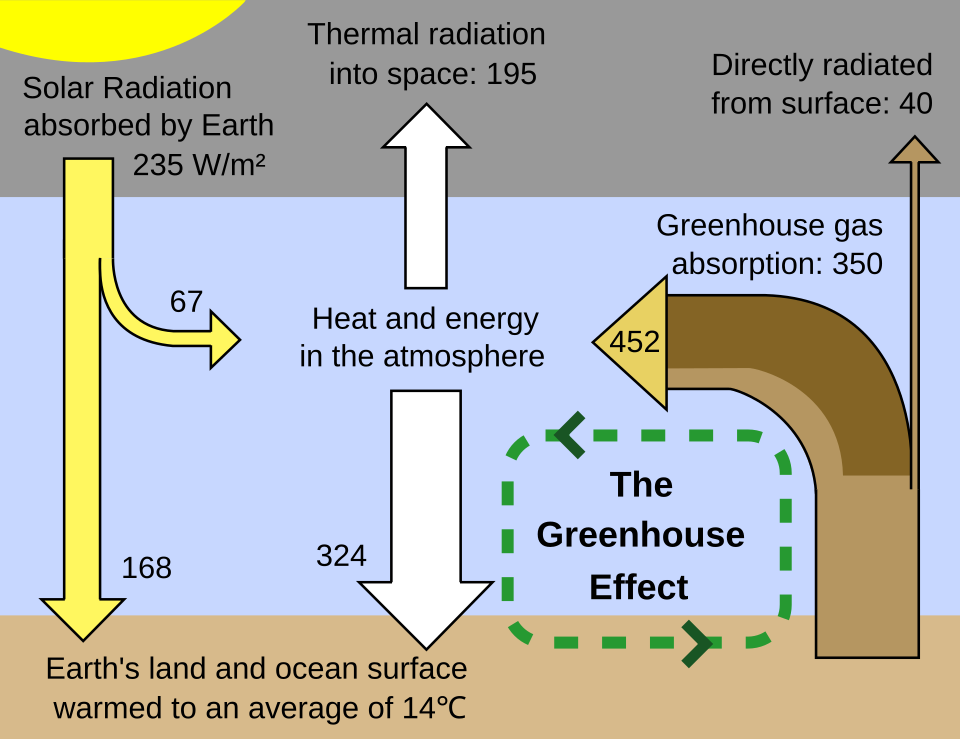
The greenhouse effect and global warming
Wikimedia Commons (CC)
process
Eutrophication Steps
Fertiliser Runoff→
Algal Bloom→
Sunlight Blocked→
Plants Die→
Bacteria Decompose→
O₂ Depleted (↑BOD)→
Fish Die
Key Points
- 1Pollution contaminates air, water, and soil from domestic, agricultural, and industrial sources.
- 2Eutrophication: fertiliser runoff → algal bloom → oxygen depletion → death of aquatic life.
- 3BOD (Biochemical Oxygen Demand) increases as bacteria decompose dead algae.
- 4Bioaccumulation: toxins build up in an organism's body over time.
- 5Biomagnification: toxin concentration increases at each trophic level.
- 6Burning fossil fuels causes air pollution (CO₂, SO₂) and contributes to acid rain.
Learning Outcomes
- Discuss the impact of biodiversity loss in local ecosystems and the important role conservation plays in limiting biodiversity loss
- Evaluate primary or secondary data relating to the effects of human activity on species diversity
- Discuss the link between atmospheric carbon dioxide, methane and climate change; evaluate biological strategies to reduce atmospheric levels of these gases