1. DNA, RNA & the Genetic Code
In brief:DNA is a double-stranded helix containing the genetic instructions for all living organisms. RNA carries this information to make proteins.
Chromosomes, DNA and Genes
Chromosomes are coiled threads of DNA wrapped around proteins (histones). Humans have 46 (23 pairs). A gene is a section of DNA that codes for a protein - only ~1% of DNA codes for proteins. The rest is non-coding DNA which contains regulatory sequences.
Structure of DNA
DNA (deoxyribonucleic acid) is a two-stranded double helix. Each strand is a polynucleotide made of repeating nucleotides. Each nucleotide = phosphate + deoxyribose sugar + nitrogenous base.
Four bases: Adenine (A), Thymine (T), Guanine (G), Cytosine (C)
Complementary base pairing: A=T (2 H-bonds), G≡C (3 H-bonds). Mnemonic: All The Genetic Code
The two strands are held together by weak hydrogen bonds and have a sugar-phosphate backbone.
Structure of RNA
RNA (ribonucleic acid) is single-stranded. Differences from DNA:
| Feature | DNA | RNA |
|---|---|---|
| Strands | Double | Single |
| Sugar | Deoxyribose | Ribose |
| Bases | A, T, G, C | A, U, G, C (Uracil replaces Thymine) |
Three types: mRNA (messenger), tRNA (transfer), rRNA (ribosomal).
Gene Expression (HL)
When a gene is 'expressed', the protein it codes for is produced. Different cells express different genes - a skin cell makes different proteins than a muscle cell.
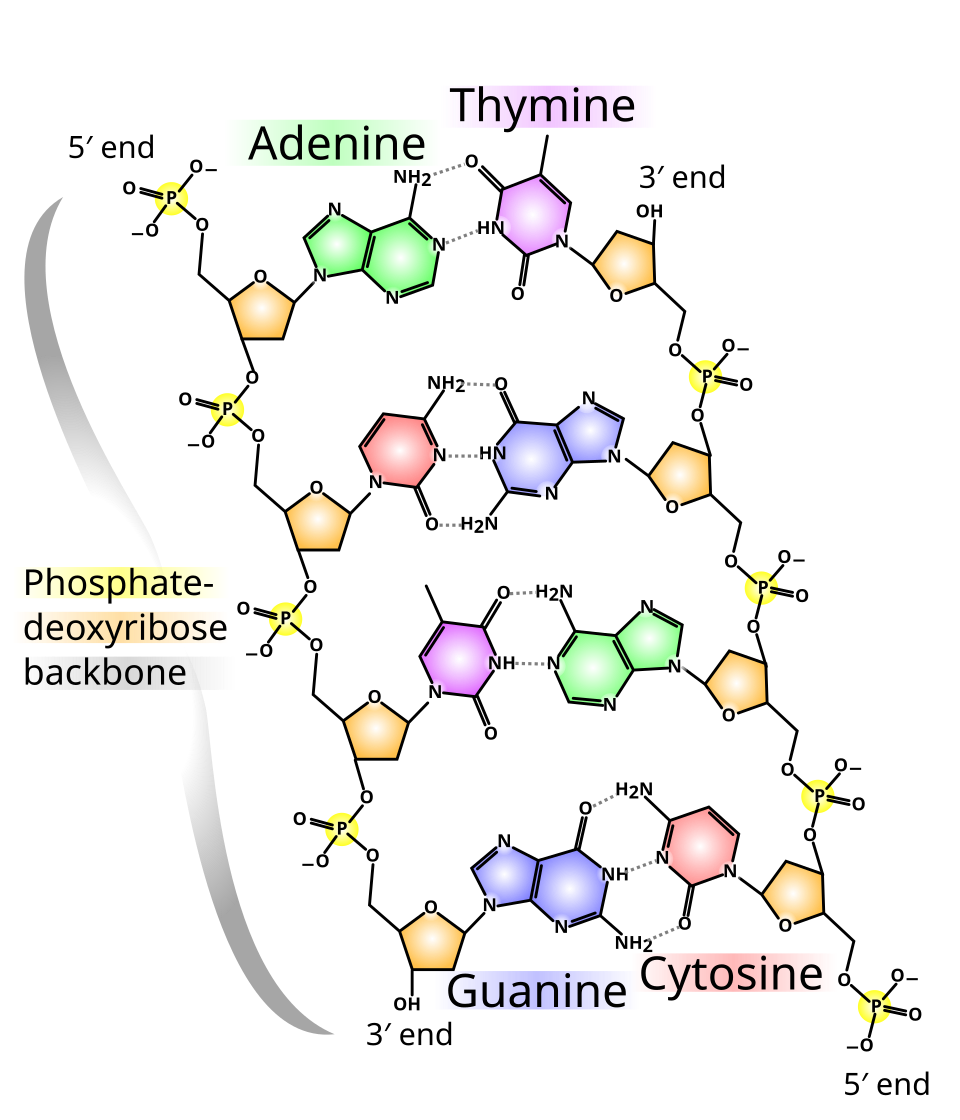
DNA - double helix with base pairing
Wikimedia Commons (public domain / CC)
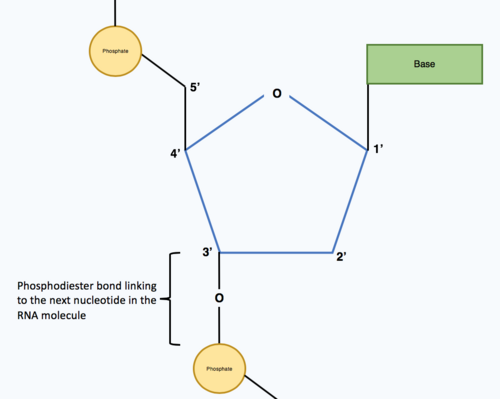
Nucleotide - phosphate, sugar, base
Wikimedia Commons (public domain / CC)
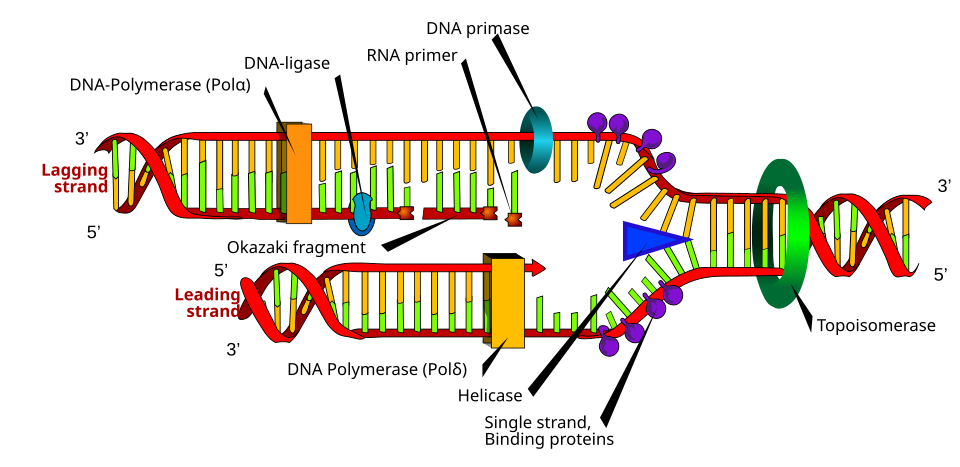
Semi-conservative DNA replication at the replication fork
Wikimedia Commons (CC)
Key Points
- 1DNA is a double-stranded helix of nucleotides (phosphate + deoxyribose + base)
- 2Base pairing: A=T (2 H-bonds), G≡C (3 H-bonds)
- 3A gene is a section of DNA that codes for a protein (~1% of DNA)
- 4RNA is single-stranded, uses ribose sugar, and uracil replaces thymine
- 5Three types of RNA: mRNA, tRNA, rRNA
- 6Gene expression: the activation of a gene to produce a protein
Learning Outcomes
- Describe the basic structure and function of a DNA and RNA nucleotide
- Relate genes, proteins and traits in organisms; outline the concept of the genetic code
- Describe the structure of a chromosome and the role of a gene