1. Flowering Plants & Plant Tissues
In brief:Angiosperms (flowering plants) have roots, stems, leaves and flowers. Their tissues include dermal, vascular, ground and meristem tissue.
Angiosperms
Angiosperms are flowering plants - the most diverse group in the plant kingdom. They produce seeds within a fruit and have flowers for reproduction.
Plant Tissue Types
| Tissue Type | Function | Examples |
|---|---|---|
| Dermal | Protection, gas exchange | Epidermis, guard cells, root hairs |
| Vascular | Transport | Xylem (water up), Phloem (sugars from source to sink, up or down) |
| Ground | Support, storage, photosynthesis | Parenchyma, collenchyma, sclerenchyma |
| Meristem | Growth (undifferentiated cells) | Apical meristem, cambium |
Xylem
Dead, hollow cells with thick walls reinforced with lignin. Transports water and minerals upward from roots.
Phloem
Living cells: sieve elements (with sieve plates) and companion cells. Transports dissolved sugars (translocation) from source to sink.
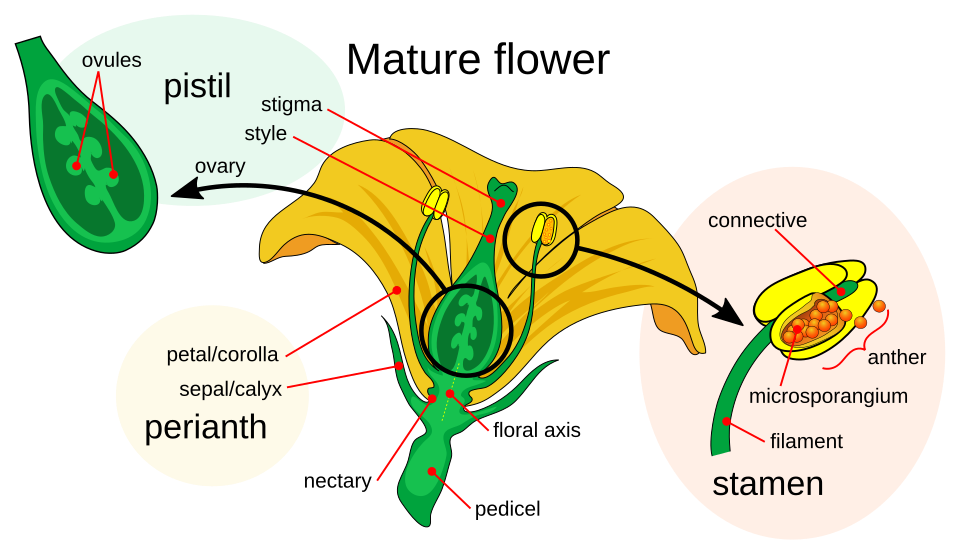
Flower structure
Wikimedia Commons (public domain / CC)
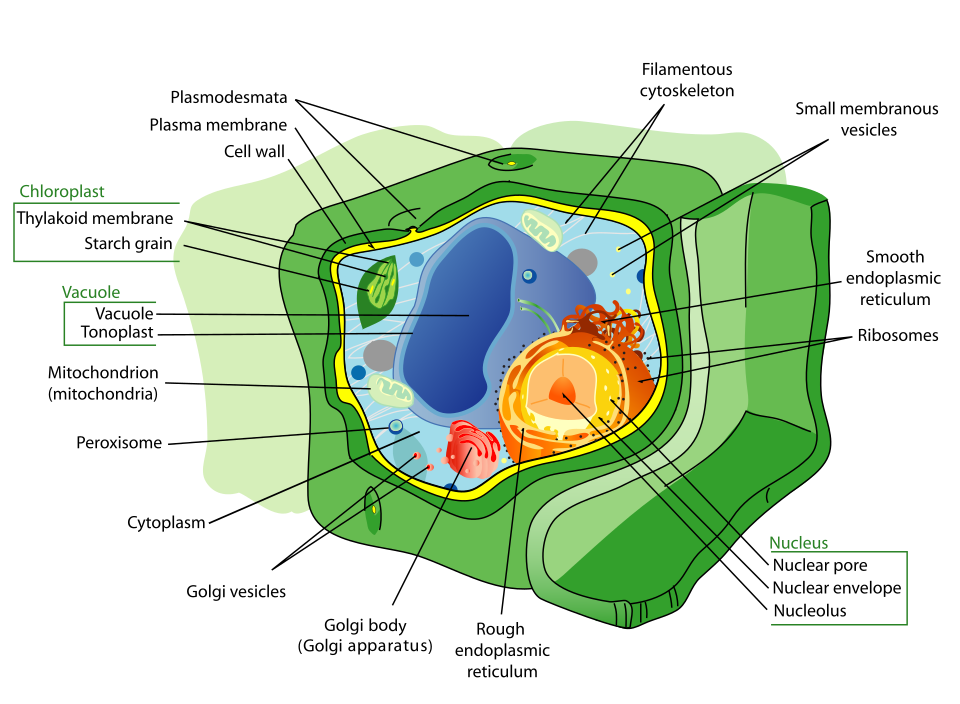
Plant cell
Wikimedia Commons (public domain / CC)
Key Points
- 1Angiosperms are flowering plants that produce seeds within a fruit
- 2Four tissue types: dermal (protection), vascular (transport), ground (support/storage), meristem (growth)
- 3Xylem: dead cells, lignin walls, transports water UP
- 4Phloem: living sieve elements + companion cells, transports sugars (translocation)
- 5Ground tissue types: parenchyma (storage), collenchyma (flexible support), sclerenchyma (rigid support)