1. Water Transport & Transpiration
In brief:Water is absorbed by root hair cells via osmosis and transported up through the xylem by transpiration pull.
Water Uptake
Root hair cells absorb water from the soil by osmosis (soil water has higher water concentration than root cells). Root hairs increase surface area for absorption.
Water moves through the root cortex by two pathways:
- Symplastic: through the cytoplasm of cells
- Apoplastic: through the cell walls
Transpiration
Transpiration is the loss of water vapour from the leaves through stomata. This creates a transpiration pull that draws water upward through the xylem.
Cohesion-Tension Model
The main mechanism for water transport up a plant:
- Water evaporates from leaf cells through stomata (transpiration)
- This creates tension (negative pressure) in the xylem
- Water molecules are attracted to each other by cohesion (hydrogen bonds)
- Water molecules are attracted to xylem walls by adhesion
- A continuous column of water is pulled upward from roots to leaves
Factors Affecting Transpiration Rate
- Temperature: higher = faster evaporation = more transpiration
- Humidity: lower humidity = faster transpiration
- Wind: more wind = faster transpiration
- Light: stomata open in light = more transpiration
Stomata & Guard Cells
Guard cells control the opening and closing of stomata. When turgid (full of water), they open the stoma; when flaccid, they close it. CO₂ concentration also controls stomata - low CO₂ causes them to open.
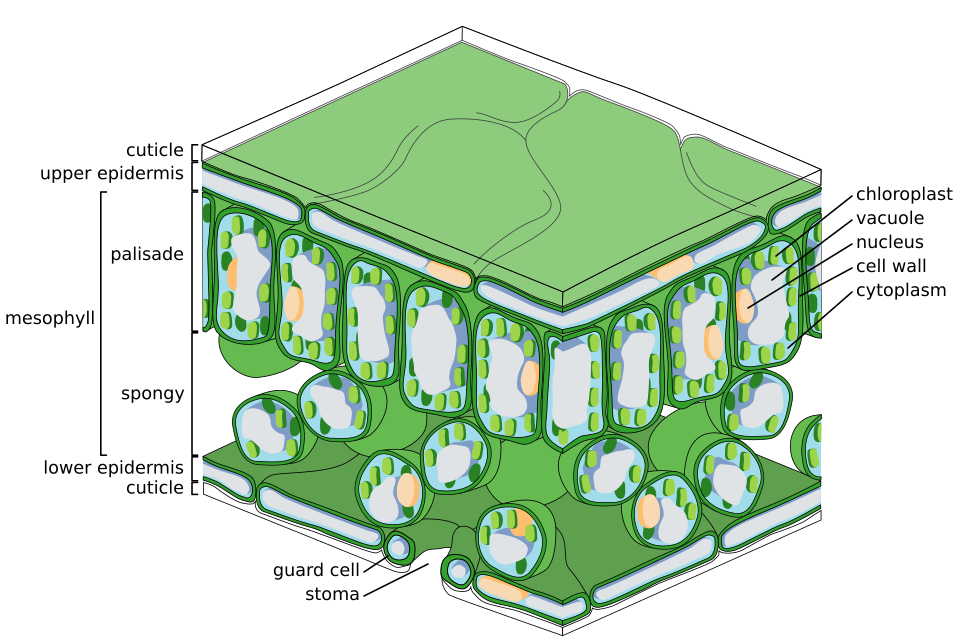
Leaf cross-section
Wikimedia Commons (public domain / CC)
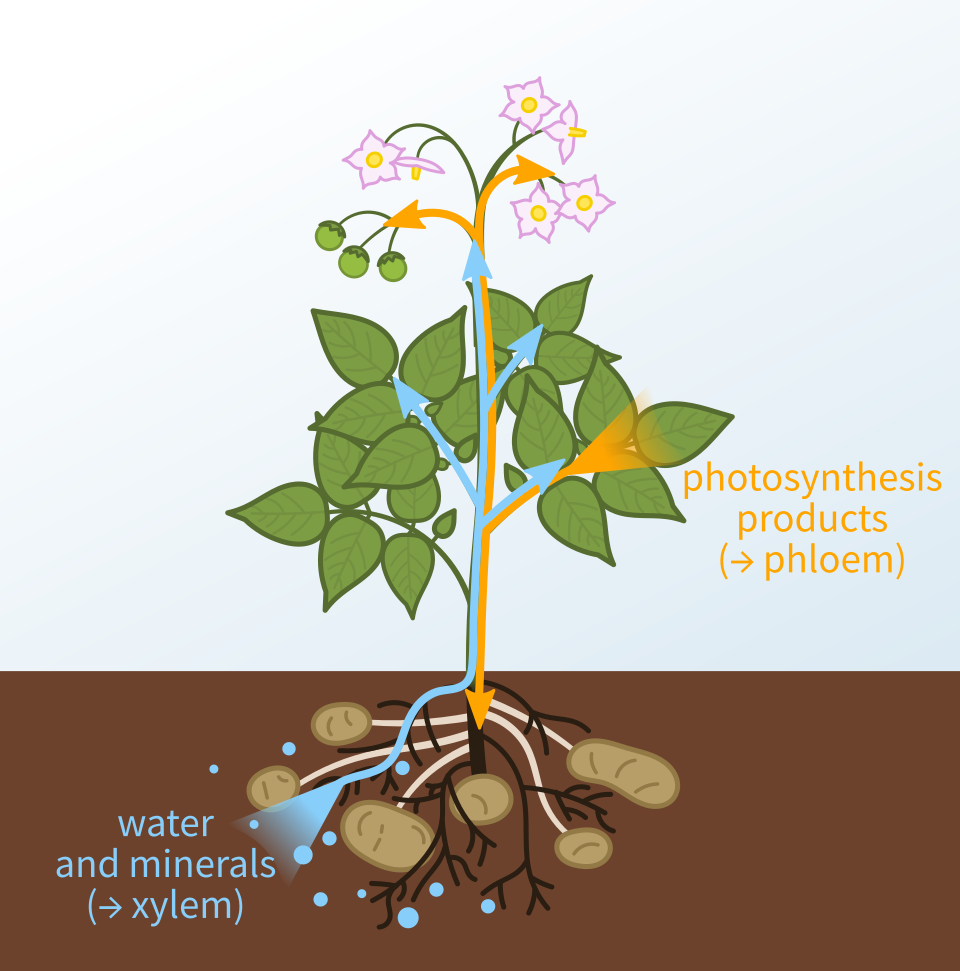
Xylem and phloem tissues
Wikimedia Commons (public domain / CC)
Key Points
- 1Root hair cells absorb water by osmosis; large surface area for absorption
- 2Transpiration: water vapour lost from leaves through stomata
- 3Cohesion-tension model: transpiration pull + cohesion of water molecules draws water up xylem
- 4Adhesion holds water to xylem walls; cohesion holds water molecules together
- 5Factors increasing transpiration: high temperature, low humidity, wind, light
- 6Guard cells control stomata opening/closing based on turgor and CO₂ levels
Learning Outcomes
- Explain the transport of water, minerals, carbon dioxide and photosynthetic products in the plant
- Investigate factors affecting the rate of transpiration in plants, use primary and secondary data to support conclusions