2.5 Human Reproduction
In brief:The human reproductive systems are adapted for gamete production, fertilisation, and development of offspring.
Male Reproductive System
Structures and functions:
- Testes (in scrotum): produce sperm (by meiosis) and testosterone
- Epididymis: stores and matures sperm
- Vas deferens: tube carrying sperm from epididymis to urethra
- Seminal vesicle: produces fructose-rich fluid to nourish sperm
- Prostate gland: produces alkaline fluid to neutralise vaginal acidity
- Urethra: shared tube for urine and semen
- Penis: delivers sperm during intercourse. Glans: head of penis. Foreskin: covering of glans
Female Reproductive System
- Ovaries: produce eggs (by meiosis) and hormones (oestrogen, progesterone)
- Fallopian tubes (oviducts): where fertilisation occurs; transport egg to uterus via cilia and peristalsis
- Uterus: muscular organ where the embryo implants and develops. Lined by the endometrium
- Cervix: narrow opening between uterus and vagina
- Vagina: birth canal and receives sperm
- Vulva: external genitalia. Labia: protective folds. Clitoris: sensory organ
The Menstrual Cycle (28 days)
- Menstruation (days 1–5): uterus lining (endometrium) breaks down and is shed
- Follicular phase (days 1–13): FSH from pituitary stimulates follicle development in ovary. The growing follicle produces oestrogen, which rebuilds the endometrium
- Ovulation (day 14): surge of LH triggers release of a mature egg from the Graafian follicle
- Luteal phase (days 15–28): the empty follicle becomes the corpus luteum, which produces progesterone to maintain the endometrium. If no fertilisation → corpus luteum degenerates → progesterone drops → menstruation begins
Pregnancy
Fertilisation → zygote → morula (ball of cells) → blastocyst (hollow ball, implants in endometrium ~day 7) → germ layers form → embryo (weeks 3–8) → foetus (week 9 to birth)
The placenta forms to allow exchange of O₂, nutrients, and waste between mother and foetus. It also produces hormones (progesterone, oestrogen) to maintain pregnancy.
Labour and birth: Oxytocin from pituitary stimulates uterine contractions. Positive feedback loop intensifies contractions until delivery.
Hormonal Control of Reproduction
| Hormone | Source | Role |
|---|---|---|
| FSH | Pituitary | Stimulates follicle development (female) and sperm production (male) |
| LH | Pituitary | Triggers ovulation; stimulates corpus luteum |
| Oestrogen | Ovaries | Rebuilds endometrium; female secondary characteristics |
| Progesterone | Corpus luteum/placenta | Maintains endometrium; supports pregnancy |
| Testosterone | Testes | Sperm production; male secondary characteristics |
| Oxytocin | Pituitary | Stimulates uterine contractions during labour |
| Prolactin | Pituitary | Stimulates milk production (lactation) |
Contraception & Fertility
Contraception methods:
- Natural: rhythm method, withdrawal (less reliable)
- Mechanical: condoms, diaphragm, IUD
- Chemical: contraceptive pill (oestrogen + progesterone prevents ovulation), morning-after pill
- Surgical: vasectomy (males), tubal ligation (females)
Infertility treatments: stimulating ovulation (fertility drugs), artificial insemination (AI), in vitro fertilisation (IVF), intracytoplasmic sperm injection (ICSI), egg freezing.
Screening: antenatal screening (ultrasound, blood tests), genetic screening (e.g. for Down syndrome), postnatal screening (e.g. heel prick test for PKU).
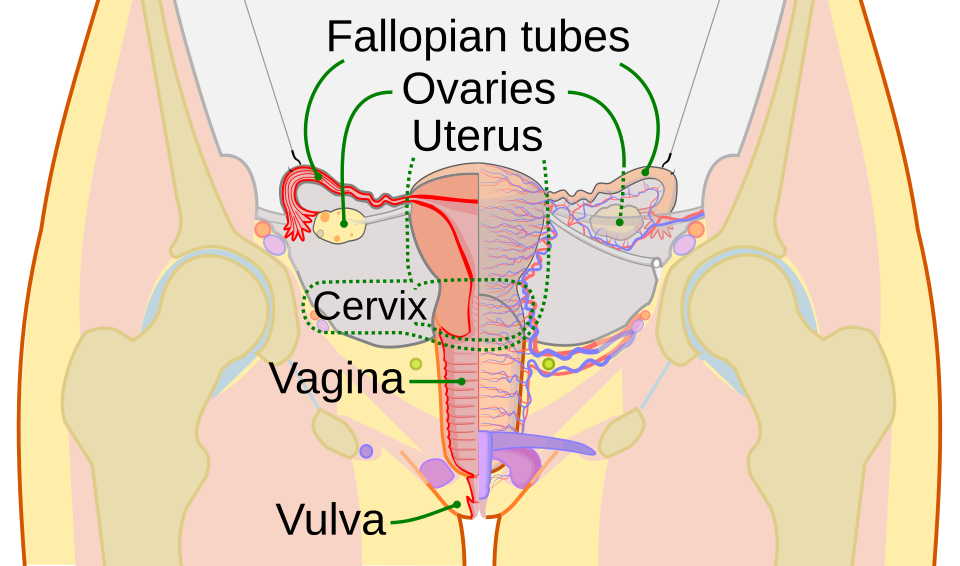
Female reproductive system
Wikimedia Commons (public domain / CC)
Key Points
- 1Male system: testes (sperm + testosterone), epididymis, vas deferens, seminal vesicle, prostate, urethra, penis.
- 2Female system: ovaries (eggs + hormones), fallopian tubes, uterus (endometrium), cervix, vagina.
- 3Menstrual cycle: menstruation → follicular phase (FSH, oestrogen) → ovulation (LH surge) → luteal phase (progesterone).
- 4Pregnancy: zygote → morula → blastocyst → embryo → foetus. Placenta for exchange.
- 5Key hormones: FSH, LH, oestrogen, progesterone, testosterone, oxytocin, prolactin.
- 6Contraception: natural, mechanical, chemical, surgical. Fertility: IVF, ICSI, AI.
- 7Screening: antenatal (ultrasound), genetic, postnatal (PKU heel prick test).
Learning Outcomes
- Relate the general structure of the male and female human reproductive systems to their functions
- Outline the phases of the menstrual cycle and the changes in hormone levels during each stage
- Describe pregnancy from the development of fertilised zygote to birth
- Model the role of hormones in the human male and female reproductive systems
- Appreciate the impact of advancements in modern technology on prenatal and postnatal care
- Discuss the use and biological implications of strategies to control fertility and treatments for infertility