All topics
Practice this topic

Unifying Strand

Scientific Investigation

SI units, designing experiments, hypothesis testing, data collection, errors, ethics, sustainability, and form fits function.

SI Units & Measurement

In brief:The International System of Units (SI) ensures scientific measurements are standardised globally so scientists everywhere can communicate data consistently.
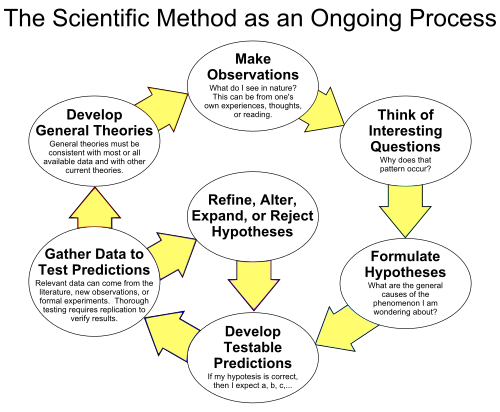
Scientific method

Steps of a scientific investigation

Wikimedia Commons (CC)

Key Points

  • 1SI Units: an international decimal system defining 7 base units.
  • 2Time = second (s), Length = metre (m), Mass = kilogram (kg), Temperature = Kelvin (K).
  • 3Luminous intensity = candela (cd), Amount of substance = mole (mol), Electric current = Ampere (A).
  • 4Derived units are combinations of base units (e.g. m/s for speed, kg/m³ for density).
  • 5Using standard units prevents miscommunication between scientists in different countries.

Learning Outcomes

  • Design, plan and conduct investigations; explain how reliability, accuracy, precision, error, fairness, safety, integrity, and the selection of suitable equipment have been considered
  • Organise and communicate their research and investigative findings in a variety of ways fit for purpose and audience, using relevant scientific terminology and representations

Designing Experiments

In brief:A well-designed experiment isolates the effect of one variable while controlling all others. This ensures valid, reliable results.

Key Points

  • 1A hypothesis must be clear, predictive, and falsifiable - not just a guess.
  • 2Example: 'When native and non-native plants are present, bees will visit native plants more frequently.'
  • 3A fair test changes only the independent variable while keeping all others constant.
  • 4Control group: receives no treatment, used as baseline for comparison.
  • 5Experimental group: receives the treatment being tested.
  • 6Double-blind testing: neither participants nor researchers know who receives treatment vs placebo - reduces bias.
  • 7Example: Testing caffeine and heart rate - IV: caffeine dose, DV: heart rate change, CVs: age, gender, diet.

Learning Outcomes

  • Recognise questions that are appropriate for scientific investigation
  • Pose testable hypotheses developed using scientific theories and explanations, and evaluate and compare strategies for investigating hypotheses
  • Design, plan and conduct investigations; explain how reliability, accuracy, precision, error, fairness, safety, integrity, and the selection of suitable equipment have been considered

Science, Society & Ethics

In brief:Science impacts society through economic development, sustainability and ethical decisions. Scientists must consider the broader implications of their work.

Key Points

  • 1Science drives economic development: agriculture, medicine, vaccines, technology.
  • 2Sustainability: maintaining environmental balance and productivity for future generations.
  • 3Ethics: moral principles guiding scientific research - e.g. animal testing, genetic engineering, data privacy.
  • 4Science and society interact: societal needs influence which research gets funded.
  • 5Form fits function: biological structures evolve specifically to match their function.
  • 6Interdependence: all living things depend on each other and their environment.
  • 7Systems thinking: biological events can be described using simplified systems and models.

Learning Outcomes

  • Evaluate media-based arguments concerning science and technology
  • Research and present information on the contribution that scientists make to scientific discovery and invention, and evaluate its impact on society
  • Explain biological phenomena using appropriate means