All topics
Practice this topic

Strand 1: Organisation of Life

Viruses

Virus structure, living vs non-living debate, viral replication cycle, and economic & medical importance.

Virus Structure & Living Debate

In brief:Viruses are microscopic parasitic agents that straddle the boundary between living and non-living. They are not classified in any domain of life.

Viruses are microscopic agents that straddle the boundary between living and non-living. They are not classified in any domain of life.

Virus structure:
Nucleic acid core: either DNA OR RNA (never both), can be single or double-stranded
Capsid: protein coat surrounding the nucleic acid. Protects genetic material and helps attach to host cells
Envelope (some viruses): outer layer made from host cell phospholipids and viral proteins. E.g. influenza, HIV
• Sizes: typically 20–300 nm (much smaller than bacteria)

Virus shapes:
Helical/rod: e.g. tobacco mosaic virus
Icosahedral (spherical): e.g. adenovirus
Complex: e.g. bacteriophage (head + tail + tail fibres)

The Living/Non-Living Debate:
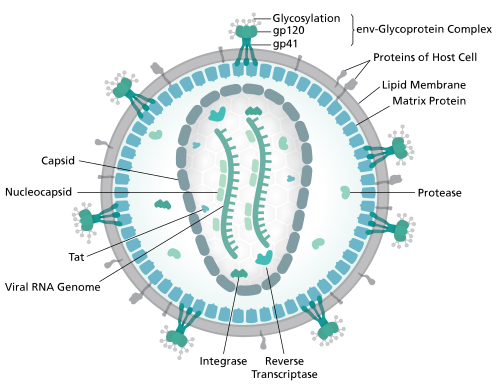
Virus structure

Structure of a virus (HIV) - capsid, envelope and genetic material

Wikimedia Commons (CC)

comparison

Are Viruses Alive?

Living Traits
  • Have genetic material (DNA/RNA)
  • Can replicate (inside host)
  • Pass genetic info to offspring
  • Can mutate and evolve
Non-Living Traits
  • Not made of cells
  • Only one type of nucleic acid
  • No organelles or ribosomes
  • Cannot metabolise independently
  • Cannot replicate outside a host

Key Points

  • 1Viruses are not made of cells and do not contain organelles like ribosomes.
  • 2Structure: nucleic acid (single/double stranded DNA OR RNA) surrounded by a protein coat (capsid).
  • 3Some viruses have an envelope outside the capsid, formed from host cell phospholipids and proteins.
  • 4Virus shapes: rod/helical, spherical, complex (e.g. bacteriophage).
  • 5Living traits: have genetic material (DNA/RNA), can replicate in host, pass genetic info to next generation.
  • 6Non-living traits: non-cellular, only one nucleic acid type, no organelles, cannot metabolise independently, cannot replicate outside host.
  • 7When outside a host cell, a virus is dormant and called a 'virion'.
  • 8Viruses are obligate parasites - they can only replicate inside living cells.

Learning Outcomes

  • Discuss the difficulty of defining viruses, their economic and medical importance
  • Model how viruses replicate within cells

Viral Replication

In brief:Viruses hijack host cell machinery to replicate. The process follows six key steps. Viruses cannot replicate independently.

Viruses cannot replicate independently - they must hijack a living host cell's machinery. The replication cycle follows six key steps:

1. Attachment: Virus surface proteins bind to specific receptors on the host cell (lock and key fit). This is why viruses only infect certain cell types.
2. Penetration: Viral genetic material (DNA or RNA) is injected into the host cell. The capsid usually stays outside.
3. Replication: The host cell's machinery makes copies of the viral DNA/RNA.
4. Synthesis: Viral genes instruct the host cell's ribosomes to make viral proteins (capsid proteins, enzymes).
5. Assembly: New virions are assembled from the replicated genetic material and newly made proteins.
6. Release: The host cell bursts (lyses), releasing hundreds of new virions that infect neighbouring cells.

This process can take hours to days depending on the virus. Each released virion can infect a new cell, leading to exponential spread.

process

The 6 Steps of Viral Replication

1⃣ Attachment
Binds to receptor
2⃣ Penetration
DNA/RNA injected
3⃣ Replication
Copies viral genes
4⃣ Synthesis
Makes viral proteins
5⃣ Assembly
Builds new virions
6⃣ Release
Cell bursts (lysis)
diagram

Visual Summary of the 6 Steps

Six Steps of Viral Replication A labelled diagram showing the six stages of viral replication: attachment, penetration, replication, synthesis, assembly and release. The Six Steps of Viral Replication 1. Attachment 2. Penetration 3. Replication 4. Synthesis 5. Assembly 6. Release

Key Points

  • 11. Attachment: virus attaches to specific receptors on the host cell surface.
  • 22. Penetration: viral genetic material (DNA or RNA) is injected into the host cell. Capsid stays outside.
  • 33. Replication: copies of viral DNA/RNA are made using host cell materials.
  • 44. Synthesis: viral genes instruct host cell ribosomes to make viral proteins. Virus hijacks host metabolism.
  • 55. Assembly: new virions are assembled from viral genetic material and viral proteins.
  • 66. Release: host cell may burst (lyse) to release new virions which infect other cells.
  • 7Each virus only infects specific cell types by matching surface proteins to host receptors.
  • 8The replication process can take days to weeks depending on the virus.

Learning Outcomes

  • Model how viruses replicate within cells
  • Explore factors that contribute to the emergence of infectious diseases in plants and animals

Economic & Medical Importance

In brief:Viruses have enormous economic and medical significance - from pandemics to vaccines, crop disease to gene therapy.

Key Points

  • 1COVID-19: huge global economic impact - job losses, supply chain disruption, healthcare strain.
  • 2Plant viruses: reduce crop yield - e.g. tobacco mosaic virus turns chloroplasts yellow, reduces photosynthesis.
  • 3Animal viruses: foot and mouth disease in cattle causes deaths, milk production loss, trade restrictions.
  • 4Vaccines: use weakened/inactive virus (or viral proteins/RNA) to stimulate immunity without causing disease.
  • 5Antibiotics do NOT work against viruses - only vaccines and antiviral drugs help.
  • 6Gene therapy: modified viruses used as vectors to carry therapeutic genes into human cells (e.g. cancer treatment).
  • 7Bacteriophages: being researched as alternatives to antibiotics - they target and kill specific bacteria.

Learning Outcomes

  • Discuss the difficulty of defining viruses, their economic and medical importance
  • Discuss the importance of a knowledge of emerging diseases in society